2006 fiction alum Scott Gould was recently featured in Pangyrus. Read an excerpt of “Playing Chicken” below: 
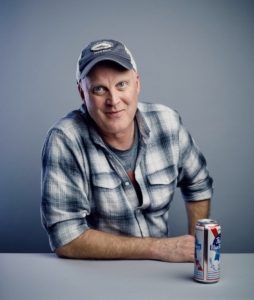
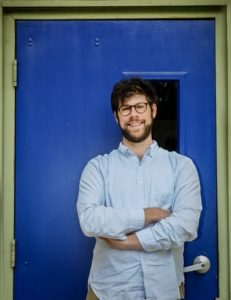
(Photo by Eli Warren) 

Playing Chicken

I am a home health nurse for Williamsburg County. My present occupation has not caused me to be shot at, molested, or otherwise screwed with because I am six feet, four inches tall and weigh two hundred and sixty-five pounds and have an attitude that repels ridicule like the back side of a magnet. The last time someone attempted humor in regard to me being a male nurse, I broke his nose. Then, I set it for him. I am a nurse because it required very little money and effort to get into tech school classes when I took leave of Parris Island, a garden spot where I lost both of my big toenails and sixteen pounds while I learned to be a war machine.

That is all to say that between then and now, I have put many a mile on my Plymouth Valiant, negotiating the swampy two-ruts of this county where people have more concern for the lotto numbers than their health. I have calculated the blood pressure of people who exist two ticks from a heart attack. I have listened to the sloshing lungs of those who smell like the insides of an ashtray. And I have wedged medicine spoons between the brown teeth of children who squirm like eels on hot sand. Through it all, I have come to believe that the human body is nothing more than a private trash heap that some of us fill to capacity faster than others.

Yet I do not come to preach. I come today with a message, and it is this: Folks you wouldn’t normally put together are winding up under the same roof. And they are getting along.

Not only are they getting along, they are growing intimately familiar and consequently having babies, crisscrossing boundaries like smugglers with a bag of dope and a bad sense of direction. It is perhaps a health situation to monitor.

Think about this:

Some months ago, I pulled the Valiant onto a road that paralleled a set of railroad tracks. Behind me, the tracks ran toward a pair of hills, where they disappeared into a curve of green trees growing so close to the tracks, the limbs were shaved and bare on one side from the constant scrape of freight cars. In front of me, the tracks eventually pulled up behind the Victoria Chicken Plant, where the slogan is right there, in big letters across the front of the building: We Are Why The Chickens Cross The Road.

During shift changes, groups of Hispanic men, wearing black hip boots and long white coats, walk between the plant and any number of trailer parks tucked in the trees along the tracks. I have an EMT buddy who gets summoned to the chicken plant once or twice a month when a line worker loses a finger to a bone saw or slips and hits his head and nearly drowns in the chicken goop on the floor. He says walking into the chicken plant is like strolling straight through the gates of hell. He told me once there isn’t enough money in the world to make him spend a shift in the chicken plant, and I told him he hadn’t been poor enough yet. I would work there before I’d starve. I just wouldn’t eat chicken tenders anymore. I would adapt.

Read this story in its entirety here: https://www.pangyrus.com/fiction/playing-chicken/
 

2014 poetry alum Daye Phillippo was recently featured in One Art. Read an excerpt of “Meanwhile the Moon is Missing” below:

Meanwhile the Moon is Missing

My six-year-old grandson, Sam, has run off with the moon again,
small, white plastic ball, cratered and lit from within that perches

perpetually full on the delicate fingertips of a white plastic hand
on my bookcase’s top shelf—Betty Adcock to A. Van Jordan,

Dickinson halfway between. The shelf is tall and so is Sam,
so the moon is within his grasp which is a metaphor I embrace

as in shoot for the moon! and the cow jumped over and one small step.
His fingertips are hungry for texture, so he rubs the cratered surface

the way phrenologists explored the size and shape of a cranium
to discern character and mental abilities…


Read this poem in its entirety here: https://oneartpoetry.com/2022/02/20/meanwhile-the-moon-is-missing-by-daye-phillippo/

2007 poetry alum Jeneva Burrows Stone was recently featured in Scoundrel Time. Read an excerpt of “Generational Neuropathy” below:

Generational Neuropathy

Politics tries to annihilate its own consequences in a bright nuclear blast. For a nanosecond, everything (for once) is illuminated. But there’s always another war to end all wars. Remember the Doonesbury cartoon about Star Wars—no, not that one, Reagan’s pet project—Oops! one got through. ‘Bye.

How will I know you in the afterlife? It’ll be recorded, I imagine.

Then the towers fell and fell, imploding story by story, all the way down. Even the great antenna. News ran on a loop of destruction, resolution, imperative, fight. The weight of history become literal. No one debated a tragedy on American soil, not even me.


Find this poem, as well as two others, here: https://scoundreltime.com/three-poems-by-jeneva-burroughs-stone/

2022 fiction alum Jared Levy was recently featured in Short Edition. Read an excerpt of “Couch” below: 

Couch

My dad came home from work and sat on the black leather couch in the living room. He always sat in the same spot. He always looked tired. Every night went the same: first work, then couch until the couch developed a large impression where his butt landed.

Until my mom kicked him out. Then I sat in the spot. I was younger then, about eight or nine, so I fell into the spot. It was like falling into a pit. It was like wearing hand-me-downs.

When my mom asked to sit in the spot, I said, “No, it’s mine.” But my mom said I couldn’t claim the spot. She said it was a little weird for me to be fixated on the spot when there were so many places to sit. What about the place on the other end of the couch where you could put your legs up? Wasn’t that more comfortable?

I ignored my mom and stayed in the spot. I came home from school and watched the same TV my dad watched: sports, ER, and any movie on TNT. When my mom got home, she said she was too tired to argue with me.

“Do what you want,” she whispered.


Read the rest of this story here: https://short-edition.com/en/story/short-fiction/couch-1

Fiction faculty member Kevin McIlvoy was recently featured in Defunct. Read an excerpt of McIlvoy’s poem “the lightning table” below:

the lightning table

don t you ever eat any sandwiches in your office

i haven t had a crumb of bread for i don t know how long

or a piece of ham or anything but apple parings

and paste leave a piece of paper in your machine

every night you can call me archy

Read this poem in its entirety here: https://defunct.site/issue/9/authors/50/kevin_mcilvoy/171/the_lightning_table

Why Are Your Stories So Sad?“, a visual essay by fiction alum Robin Black, was recently featured in Defunct. Find Black’s essay at the link below.

https://defunct.site/issue/9/authors/60/robin_black/198/why_are_your_stories_so_sad

Poetry alum Matt Hart was recently featured in Defunct. Read an excerpt of At Night I Sing My Heads to Sleep below:

At Night I Sing My Heads to Sleep

18

With a lion’s great head on my head I go thunder,

with tears on my cheeks, in a house that’s only fire.

I am not here for the righteous,

I am here in solidarity with the ones who aren’t sure,

especially the ones who know only they aren’t sure.

It’s wonder/full——uncertainty——but it also makes us anxious.

Imagine a dream where you dream you imagine!

A toast to the ghosts in our book bags and pockets!

Read this poem in its entirety here: https://defunct.site/issue/9/authors/37/matt_hart/167/from_at_night_i_sing_my_heads_to_sleep

2018 poetry alum Megan Pinto was recently featured in Hyphen. Read an excerpt of “Bloodshot” below:

Bloodshot

The doctor traces my orbital bone 
with her finger, asks 
when was it last that I slept, 
and who do I call 
when I’m scared? 

Read this poem in its entirety here: https://hyphenmagazine.com/blog/2022/02/poetry-bloodshot-megan-pinto

2002 fiction alum David Rutschman was recently featured in Defunctmag. Read an excerpt of “The Father Becomes a Cloud” below:

The Father Becomes a Cloud

Slowly, over years, the father becomes a cloud. At first only occasionally, around the edges.

The mother tries to sort out next steps.

The doctor asks him the day of the week, to count backward from 100 by 7’s.

The doctor names three objects: an orange, a pen and   something else  and later asks him to repeat the three. Dirty trick.


Other doctors, scans.

Read this poem in its entirety here: https://defunct.site/issue/9/authors/42/david_rutschman/134/the_father_becomes_a_cloud

Jen Ryan Onken, a 2020 poetry alum, was recently featured in the LEON Literary Review. Read an excerpt of “Ode to Ambivalence” below:

Ode to Ambivalence

Drop it. Slowly. Let care go
like a dirty hankie. Don’t
pick it up. Who needs chivalry?
They don’t see you: you’ve let
your hair go grey. Who cares?
Lose four committees. Lose raises
after earning your degree. Lose
all sense of ownership over 
the toaster waffles. Rule the house
by order of the tumbleweeds. Grow
accustomed to the truth: people will
do everything better. Feel the dull
scrape of mother over your gluten-free
toast. Ambivalence is a crone’s
disease. The gurgle of despair—
the world, not your oyster, but someone
else’s Dover Sole. Forget about it.

Read this poem in its entirety here: http://leonliteraryreview.com/issue-12-jen-ryan-onken/