
2007 poetry alum Katie Bowler Young was recently interviewed about her biography Enrique Alférez: Sculptor for Artworks, the weekly podcast of the National Endowment for the Arts. Read an excerpt of the interview (and find a link to the podcast) below:

An Interview with Katie Bowler Young

Jo Reed: I wanted to talk about art in public space. He certainly has work in museums as well and private collections. But perhaps using [Enrique] Alférez as a jumping off point, I’d like your thoughts on what art in public spaces brings to a community.

Katie Bowler Young: At its best, I think that public art provides a sense of comfort, reinforces identity and connection to place. When I reflect on my own point of origin for this book and think about the difficult period that I was going through and how I found a sense of security because I had access to the art that was in a public space, because I could sit there freely and admire it without being shooed away, there was no concern about my lingering there for extended periods of time and it gave me a place that I felt kind of protected from the worldly realities that I otherwise was facing and it began to spark curiosity and I think that curiosity is such an important part of inspiring us in terms of just how we live our lives that that’s the best that we can get from public art.

Jo Reed: One of the many things I find so fascinating about Alférez’s work is that it is very distinctive and at the same time, most of his work was done in collaboration.

Katie Bowler Young: It’s one of the interesting parts of sculpture and particularly of the sculpture of this size, that as many as 15 or so people might be involved and it could take many months and if you look back at some of the architectural details that he created as well, that too was a collaboration with an architect who would have provided him with details or a narrative of what they were looking for and Alférez would have submitted drawings and that too, I think of as a collaborative, creative process. My instinct is that that is something that Alférez really enjoyed about sculpture as a form, as a discipline and he also drew extensively and I see that as more of what he was doing on his own and that too I see echoes of in my own work as a writer, looking at the writing or the work that I am doing by myself versus those pieces of what we create as writers that come from the network of people who in some way are influencing the words that end up on our pages.

Jo Reed: Now, we began this conversation by acknowledging you as a poet and I want to talk about process, your process, for a second and describe the differences for you in writing poetry and writing this biography.

Katie Bowler Young: Writing prose and writing poetry have a lot of similarities and a lot of differences. If there are points at which there are– let me take that from the top, Jo. Yes. So, in thinking about the differences between my approach to poetry and my approach to writing this biography, I can say that one thing that was consistent was my form of discipline, the time of day that I worked, approach to writing. What was very different was the type of research that needed to be conducted as well as the extraordinary amount of fact-checking, which of course, I also do in my poetry as well. If I am writing about particular birds or environmental landscapes, I will fact check myself to make sure that I’ve included the right details of nature. I think that one of the things that I find an interesting connection between my interest in poetry and my interest in Alférez’s art and writing biography really is also about the discipline of the visual artist. I very much enjoy writing about artists and their process, watching them work, seeing how they provide– I’m going to take it from the top again, Jo. This is a really interesting topic and I want to try to get it right. Thinking about my interest in writing both poetry and then also writing about art, I’m intrigued by the process that artists take when they are creating any form of visual art. So, whether they’re painting or sculpting or creating pottery or other clay works, I’m intrigued by the attention to detail, how they will spend a certain amount of attention to the detail in one area and then also give attention to the work as whole and that too is something that I think of as crucial when you’re working as a poet, that you are seeking just the right word to put in just the right place and in this economy of detail, it needs to be just so.

Read the rest of this interview, and listen to the podcast, here: https://www.arts.gov/stories/podcast/katie-bowler-young#transcript
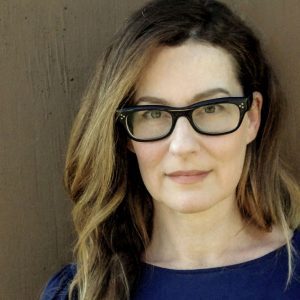
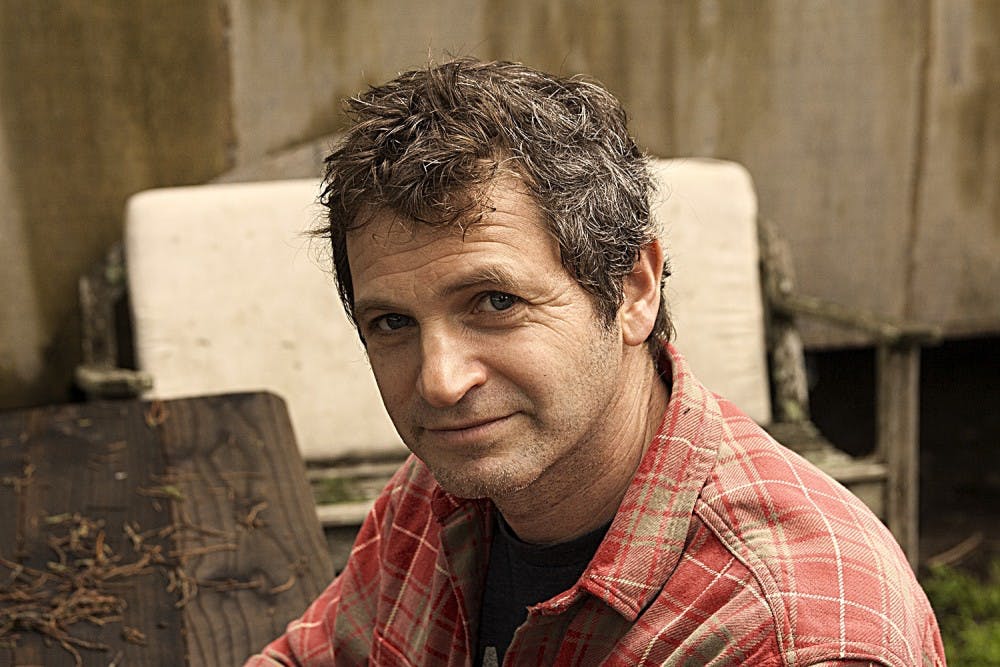
The Millions recently interviewed 2010 fiction alum Karen Tucker. Read an excerpt of the interview below:

You Live and Die by the Prep Work: The Millions Interviews Karen Tucker

Whitney Gilchrist: When people ask you what your book is about, what do you tell them? Is it a different answer from how you described it when you were writing it?

Karen Tucker: As someone with questionable skills in the verbal department, I usually say something like, “You know. Friends, drugs,” and let my voice trail off. Sometimes I add the food server angle, and––depending on who I’m talking to and their personal interests––I’ll mention the many pee and poop jokes. I’ve found “trauma and grief and substance use disorder” doesn’t quite have the same zing.

WG: With addiction so stigmatized and misunderstood, you must have made countless decisions in order to write about it responsibly. Could you talk about the choices you made that you felt were important in portraying the opioid crisis?

KT: The correct answer is that I’m an irresponsible writer, since I spent little to no time considering how to present the opioid epidemic in a responsible fashion.

Certainly I did copious research to better understand how this disaster unfolded (late capitalism strikes again!), but my obligation, as I saw it, was to portray these characters’ lives as fully as possible. To not omit the moments of genuine joy and pleasure, and to avoid prettying up any ugly choices or brutal events.

Not that this was easy. Among other things, Bewilderness is about a painful disorder––and who wouldn’t want to inject a hefty dose of order if it meant relieving some of that pain? I did my best, slipped up plenty, and at last I had a novel. No doubt I would have abandoned the manuscript in its earliest stages if either I or the characters always did the responsible thing.

Read the rest of this interview here: https://themillions.com/2021/08/you-live-and-die-by-the-prep-work-the-millions-interviews-karen-tucker.html

Fiction faculty member Peter Orner was recently featured by the New Yorker. Read an excerpt of Orner’s short story, “Barbara, Detroit, 1966,” below:

Barbara, Detroit, 1966

That’s Barbara in the third row from the back of the sanctuary, the one with the sunglasses holding up her tangle of orange hair, see her? Hair like a nest of copper wiring? The one slowly rocking? Both hands beneath her belly as if she were holding a large salad bowl; she’s more than eight months pregnant. It’s February 12, 1966, and Barbara’s in the new Shaarey Zedek in Southfield, six exits away from Chicago Boulevard, Detroit, where the old synagogue used to be. It’s still there, actually. Now they’ve sold it to a Pentecostal church. It’s been four years since the congregation decamped to the suburbs, and the new place still gleams. The fresh paint smells like vanilla, and the triangular point of the roof inspires as it juts out across the freeway like a plane taking off. At the moment the place is jammed, more than seven hundred people, not a seat is empty. It’s hot, and Barbara’s woozy. All she wants is for the service to be over so she can go home. She’s here because she didn’t want to be at home. The circle of life. From one place we don’t want to be to another.

And still the rabbi talks. The renowned, beloved, silver-tongued Morris Adler, “the most quoted rabbi in America,” intones, expounds on Abraham Lincoln in honor of the sixteenth President’s birthday. Barbara’s paying no attention.

She’s forgotten her regular glasses (what’s there to see in temple anyway?), and, for no reason she’ll be able to explain later, she slides her sunglasses down onto her face. Everything goes darker as her hair collapses to her shoulders.

Rabbi Adler’s voice tends to slow when he’s nearly finished—son . . . his . . . own . . . flesh—and so there’s hope that this could end, and Barbara becomes, incrementally, more awake. The rabbi’s words are like shapes, and she imagines them raining from the skylights like fat white drops of light, plopping one by one on her head and on the heads of all the others, the ones who’ve been listening and the ones who’ve been dozing, exploding with a little piff that only Barbara is attuned to hear.

Read the rest of this story here: https://www.newyorker.com/books/flash-fiction/barbara-detroit-1966?

Rose Auslander, a 2015 poetry alum, was recently interviewed for Carve Magazine. Read an excerpt below:

An Interview with Rose Auslander

What do you love most about writing poetry?

I love trying to spin the world into a web of words.  And I love those times when it feels like those words turn into a world of their own.

What subject matters are the toughest for you to tackle in your poetry? Which topics are you most drawn to?

I love living on the water, and my poetry is soaked in it.  For years, it was the ugly beautiful of the Gowanus Canal—the bright blue Carroll Street Bridge reflected in stinky, discolored waves.  These days, it’s Aunt Betty’s Pond on Cape Cod (I just typed “Cape Cold”) and its itinerant swans.

Hard as I try to find sanctuary, though, the political world seeps through. Writing that implicates politics is tough, but necessary—sadly unavoidable.  Honestly, though, it can be a struggle to avoid being didactic—essay, not poetry.  To get to anything real, I have to press where it hurts—into personal vulnerability and self implication.  When I back off and start feeling sorry for myself, I make myself come back to Seamus Heaney’s “Punishment,” studying how relentlessly he implicates himself and how he makes the reader feel complicit.  

Love is hard, too.  I don’t write many love poems—and the ones I do are more John Lennon than Paul McCartney.  There’s always a dark side.   

Read the rest of this interview here: https://www.carvezine.com/from-the-editor/talking-with-rose-auslander

2014 fiction alum Christy Stillwell was recently featured in The Rumpus. Read an excerpt of “Hatch” below:

Hatch

The river boiled with trout. Alan Blake was beside himself. Guides reported monster fish from River Junction all the way through the box canyon. All day Friday in surgery, the doctor spoke of his plans to float the river, dismissing talk that the water was too high. Patients were wheeled in and Alan ordered the volume up on his jazz station, put his head down, and got to work. He wasn’t short with anyone. He hardly minded when a nurse dropped the retractors and the autoclave was empty; another pair only had to be fetched from down the hall. What did it matter? It was June and the salmonfly hatch had begun.

In between cases, Alan buzzed with energy. His boat was already packed, his shuttle set up. He had chosen a less popular section of water, with lots of snags and curves. This was Father’s Day weekend and the banks would be swarmed with waders. He didn’t like crowds. Higher water meant fewer boats. Besides, bugs didn’t care about snags and curves. If the reports were correct, he would see willow branches, shore sedges, even marsh grasses bending under the weight of salmonfly clusters.

The salmonfly was a slim bug, beetle-like, with long antenna. A mature female could be as long as a man’s middle finger. The sole purpose of its short adult life was to mate. Heavy with cargo, the females would skim the river surface and pump a dark, pea-sized egg sac into the water. Clumsy, exhausted, knocked by the wind, the females most often ended up in the river. A fisherman could sink his fly, imitating nymphs swimming towards metamorphosis, but Alan preferred dry fly fishing. It took more skill. He could lay his fly on the water with profound gentleness, a perfect simulation of the doomed female’s erratic flight after delivering her egg bomb. Once she hit the surface, the struggle didn’t last long. As if she knew her work was done, she would tuck in her wings and become still, waiting to be consumed.

Read the rest of this story here: https://therumpus.net/2021/08/rumpus-original-fiction-hatch/?

Fiction faculty member Caitlin Horrocks was recently featured in Essay Daily. Read an excerpt of Horrocks’ essay below:

The Cottage Essay

When I think about Michigan essays, what I find myself thinking about is a subgenre I’d like to call “the cottage essay,” or maybe “the cabin essay.” It’s rarely a “lakehouse” essay, but it could be. I can’t always tell, in these essays, how large or well-appointed or house-like the cottages are. Sometimes my students just write about “my grandparents’ place.”      

In Michigan, it’s not necessarily the richest people who have lakeside property, but the people who have lived here the longest. Wealthy people from Chicago might still simply buy a cottage. But for most of my students, for most of the people I know, your main choices are to rent one by the week or weekend, or to inherit or be hosted in one that was bought in another era, by an earlier generation, when such purchases were in easier reach. I was born in Michigan, but my parents were transplants. My husband is from Seattle. We write and teach. We will probably never have a cottage. But I read a lot of cottage essays.      

Most have one of three shapes: the first is more commonly by a beginning writer, and it is an essay about joy. The joy is cozy and regular, without beginning or end—the writer anticipates the same joy every summer (the cottage essay takes place almost always in summer, though the cabin essay might also take place in autumn deer hunting season, or winter snowmobile season).  The writer’s joy is so perfect and private and steady that it becomes a vague fog to the reader. We talk about this, the “problem” of joy, how odd and unfair it is that it’s so much harder to convey in interesting ways than tragedy. The student’s patience for this conversation tends to correlate to their patience for writing in general.

Read the rest of this essay here: https://caitlinhorrocks.com/

2017 poetry grad Tiana Nobile was recently interviewed for Apogee. Read an excerpt of the interview below:

Tender Excavations: Retelling Origin Stories in Adoption Narratives

Leslie SainzCleave is no stranger to poetic erasure—the poem “The Stolen Generation” features an erasure of the Aboriginal Protection Act of 1869 and the Aborigines Protection Act of 1886, and the book presents and manipulates documents that pertain to your transnational adoption, including a letter requesting that you, as an infant, be baptized. In reading and rereading these poems, I was reminded of Solmaz Sharif’s essay “The Near Transitive Properties of the Political and Poetical: Erasure” and her discussion of erasure as “obliteration,” as assuming the role of the state. In the context of transracial and transnational adoption—a system built on abandonment, separation, and trauma that is hallmarked by not only the removal from one’s birth country but oftentimes one’s birth culture and language—I’m curious about how you arrived at the decision to employ erasure on actual source materials. How did your sense of agency shift when you applied your adult hand to documents that blatantly pointed to your inability to consent?

Tiana Nobile: Historically and politically, it’s true that erasure most frequently equates some form of violence on behalf of the state. What, then, does it mean to enact an erasure in the opposite direction? “The Stolen Generation” is named after the countless aboriginal children who were forcibly removed, in some cases literally kidnapped, from their families and given to white Australian families for adoption. This horrific practice is not unique throughout history (you might have heard about the mass grave of Native children, some as young as three years old, that was recently discovered at a former “residential school” in Canada), and its purpose was to essentially erase aboriginal life and culture from Australia. This is genocide, possibly the most egregious form of erasure. Reading the legislation that made these acts legal was illuminating and appalling; they’re called the Aboriginal PROTECTION Acts for fuck’s sake! It felt necessary to call attention to that hypocrisy in the poem.

I’ve been a student of erasure for a while, and I’ve learned so much about the power of subversion. Solmaz Sharif’s Look and Srikanth Reddy’s Voyager are two groundbreaking examples of this. To manipulate the language of the oppressor in order to disrupt that version of the truth and uplift a previously silenced perspective is a powerful political act and one that really spoke to me as I began working through my own archive of records.

Erasure is particularly special because it points to so many layers: the original text, what is missing from the original, and the newly constructed, unearthed narrative. To be simultaneously immersed in a white family, stripped of any cultural ties to my country of origin, and for the reflection in the mirror to be an ever-present reminder of this migration and loss—I think of my body as a physical manifestation of palimpsest. In Cleave, erasure provides me with a poetic space to reckon with the erasure that happens as a result of adoption. It enables me to re-frame the stories I was told. I can finally uncover what is submerged within the language of my paperwork, give it a voice, and demand visibility.

Read the rest of this interview here: https://apogeejournal.org/2021/08/03/tender-excavations-retelling-origin-stories-in-adoption-narratives/

2012 poetry alum Ellen McCulloch-Lovell was recently featured in Grey Sparrow Journal. Read an excerpt of McCulloch-Lovell’s poem below:

When I Stepped Onto the Deck After Sunset

When I stepped onto the deck after sunset
a sliced moon floated low in a circle of its own light―
no stars at that level, only one sure beacon in the southwest―
I thought it must be Venus. Against shaded blue, maples pressed designs,
so fast had new leaves unfurled this warmest May day.

From a vernal pool I heard peepers
chirring, thrilled to be back in their bodies.
White porch chairs glowed ghostly, as if
last summer’s guests just left, food smoke dispersed.

Read the rest of this poem here: https://grey-sparrow-press.com/38-when-i-stepped-onto-the-deck-after-sunset-ellen-mcculloch-lovell/

2020 poetry grad Eric Cruz was recently featured in Zocalo: Public Square. Read an excerpt of Cruz’s poem “Missing Church Again” below:

Missing Church Again

Today, no song, God, repentance
ringing as words flute up through rafters.

What remains: a bird feeder heavy
with seed, like a soon-to-be

mother swaying. And finches,
cardinals, away from heaven,

as black seeds slide down their throats.
Nothing survives

this world without faith,
without rising out of oneself

into the dream of shared need.
It’s because I’m done kneeling

that I walk beneath the sky’s blue
vein as the pulse of my own

sadness widens there, until at last
it is enough to cut open

a bag of seed and drift. Please grant
me peace of mind and calm

my troubled heart. And what I mean is wings.
I mean singing and for small bodies

to shadow the yard. Funny, I can imagine
them falling through the temple

of silence, early morning burning
orange along the lip of the horizon.

Read the rest of this poem here: https://www.zocalopublicsquare.org/2021/08/06/eric-james-cruz-poem-missing-church-again/chronicles/poetry/

2016 poetry grad Lara Egger was recently featured in Sixth Finch. Read an excerpt of Egger’s poem below:

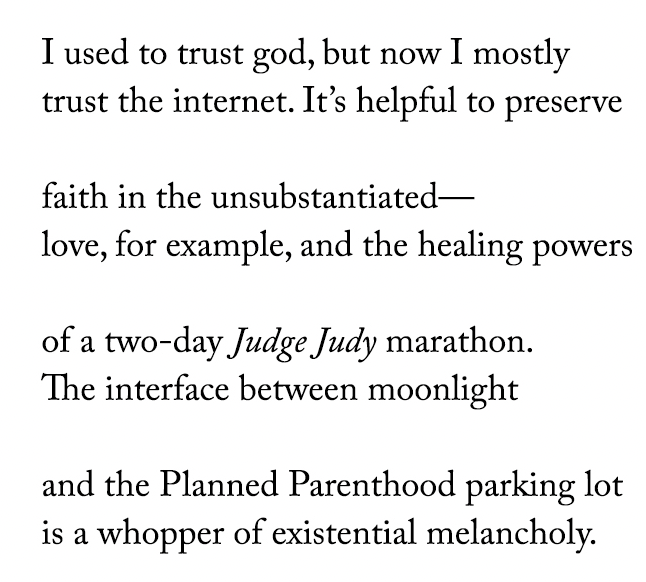
How to Operate Heavy Machinery

Read the rest of this poem here: http://sixthfinch.com/egger1.html