
“You Don’t have to Be Tough All by Yourself, You Said” and “Zuihitsu with Love for the Moon’s Failed Rebellion” by Cynthia Dewi Oka (poetry ’19), published by Scoundrel Time.

You Don’t Have to Be Tough All by Yourself, You Said

and if I returned the favor, it was much later. Or
I lied. At the airport, waiting for my turn to sleep. Like a leg
bone inside a grasshopper. In the selfie I sent, darkness

curtains one side of my head which hasn’t thought
of Christopher for years. Aside from his occasional Facebook
posts captioned #blessed below boys in blue

jerseys #despite the Canucks’ losing streak. The Rockies
look photoshopped, but not the beetlelike sacs
under his mother’s eyes. All seasons, petals by a jacuzzi. Cherry-

flavored hospital jellos on the lid of the grill. Unless
they’re margaritas, O, winking emoji #FUCKCANCERGOCHEMO!
I should’ve sent his mother a letter. Something about that year

[…continue reading “You Don’t have to Be Tough All by Yourself, You Said” and find “Zuihitsu with Love for the Moon’s Failed Rebellion” at Scoundrel Time. You can also find Cynthia Dewi Oka’s writing on Aracelis Girmay’s “Arroz Poetica” at Poetry Daily as well as another poem, “Meditation on the Worth of Anything,” at Tupelo Quarterly.]

A craft essay by Alyson Mosquera Dutemple (fiction ’19), published by Craft.

Suspense in Flannery O’Connor’s “The River”

Long before we discover that the main character, a little boy named Harry, will drown in the final moments of Flannery O’Connor’s “The River,” we are unsettled while reading the story. On the surface, the main actions before the drowning are not particularly threatening (Harry visits with a new babysitter, takes a trolley ride, and attends an informal religious service down by the river), but O’Connor makes specific choices that turn these ostensibly mundane activities into ones that seem rife with potential danger. Using setting, characterization, and pacing, O’Connor infuses even the smallest moments of Harry’s day with heightened suspense, building piece by piece to the cathartic but fatal final moments in the story.

[…continue reading at Craft.]

“Apella” by Dilruba Ahmed (poetry ’09), published by Poetry.

Apella

This morning, a light
so full, so complete
we might ask why

the god of sun
is also god of plague,
why the god of healing

also god of archery.
The children under trees—
unaware their hearts

have become targets
red and inflamed
as the eyes of men in thrones—

find sticks in the grass
to fashion into guns. Some brandish
a branch-saber. They are sniping

the golden light
with squinting faces.

[…continue reading “Apella” at Poetry. You can also read three more poems by Dilruba Ahmed (poetry ’09) at Four Way Review.]

“The God Structure” by Chloe Martinez (poetry ’09), published by The Common.

The God Structure

“It has a god structure. I think it will resist a long time.”

—Customer review of the Uniqlo Beauty Light bra, $19.99

O keep me up, keep me going. Keep it together. Smooth me. Reduce
excess movement. There is a heaviness. There is around me a
God Structure. It helps me organize my thoughts. It has laid out
plans, I think, for various eventualities, and the existence of plans,

though they change, is a comfort. This morning the God Structure
led me to a vine that was drooping over the far edge
of the front lawn, covered with ripe blackberries. God Structure said,
Eat them, and I did. The stain of them still on my hands when I heard

that the God Structure had also made a disease that is suddenly taking
from my friend his body, among other things. It seems the God Structure
doesn’t give a shit, has no alternate plan. Keep Google-ing it, nothing
appears. His tongue tries to choke him in his sleep. His God Structure is

written into his code: it was always there, in silence, inevitable.

[…continue reading “The God Structure” at The Common. You can also read more of her work in the recent Fall 2019 print issue of Prairie Schooner.]

“On Chickens, Children, and Fascism” by Emily Sinclair (fiction ’14), published by The Missouri Review.

On Chickens, Children, and Fascism

Before I got baby chicks, I attended chicken class at Wardell’s Feed and Pet, a few miles down the highway. Eric, the chicken class teacher, sold me a brooder. If you don’t know, a brooder is a kind of substitute mother hen: it’s a box with a heat lamp and a feeder and waterer. The chicks live in it until they’re eight weeks old and ready to move outside to the coop. It’s obvious to me why a substitute mother is called a brooder. Motherhood for me is characterized by an ongoing sense of worry and inadequacy.

[…continue reading “On Chickens, Children, and Fascism” at The Missouri Review.]

“The Book of Kells” by Joy Manesiotis (poetry ’86), published by Poetry.

The Book of Kells

But then four crows—no, maybe ravens—those large, black birds big as dogs, 
like gentlemen, crossed the path, looking up, contemplating something invisible,

feathers on their crowns at attention, as if waxed into style, sun polishing each upright stalk, 
asphalt, grass visible between each black spear, the way, when younger, we spiked

our hair before dancing all night at an after-hours club, but I don’t know
what it means now: Rocking gait: slow procession: pondering a shared question—

unseen force drawing them across the road or a predator overhead
or walking away from despair hidden in the heart. She looks

to be holding a miniature man in her lap, the Mary of Kells. He has
two left feet. And she stares, her face a mask of sorrow, eyes flattened, looking ahead.

[…continue reading “The Book of Kells” at Poetry.]

Two poems by Amanda Newell (poetry ’17), published by Cultural Weekly.

Permanent Girl

She’s fifty now   tired of riding the blue anchor etched into his left
bicep    tired of being his USNA pinup girl   always fighting gravity   bubbled

tits & ass sagging on the freckled folds of his skin.  The things she’s seen!
The pool halls!   Sundays at Charles Town   the Hollywood Casino   his favorite.

[…continue reading “Permanent Girl” as well as a second poem, “Black Angus,” at Cultural Weekly.]

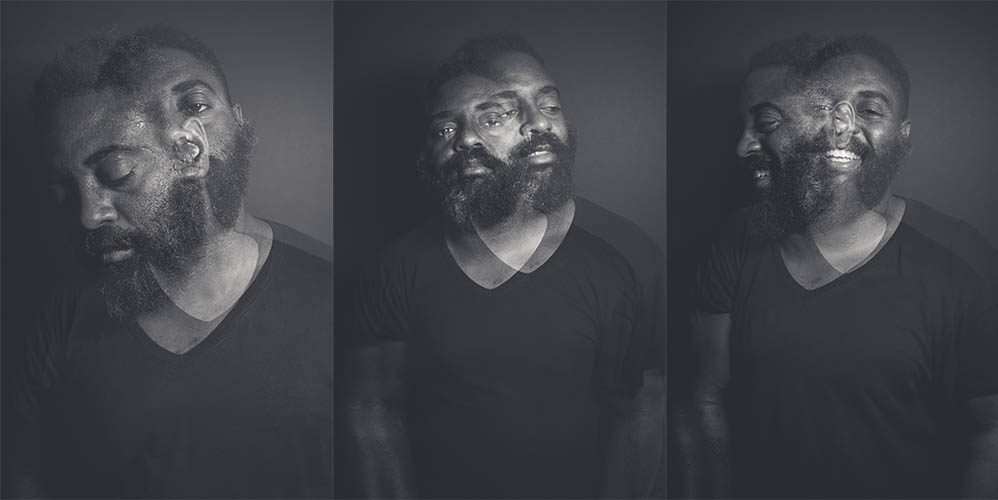
REGINALD DWAYNE BETTS TRIPTYCH BY RACHEL ELIZA GRIFFITHS

An interview conducted by Rachel Eliza Griffiths with Reginald Dwayne Betts (poetry ’10), published by The Paris Review.

INTERVIEWER

One of the first things I noticed about the book is the cover, which features the art of Titus Kaphar. You and Kaphar collaborated on “Redaction: A Project,” an exhibition at MoMA that draws on source material from lawsuits filed on behalf of people incarcerated because of an inability to pay court fines and fees. You have four poems in Felon that are erasures/redactions with specific titles (“In Alabama,” In Houston,” et cetera). They’re all mappable, yet the erasures show the systematic obliteration of black life. Could you speak about this?

BETTS

I’m trying to find ways to connect my identity as a lawyer with my identity as a poet. I’m on the board of the Civil Rights Corps, which deals with money bail. They are specifically trying to challenge the fact that many states incarcerate people and leave them incarcerated just because they can’t pay their bail or because they owe fines for traffic tickets or things like that, citations.

But nobody can understand these court documents. I mean, you get sixty to seventy pages. It’s like reading a novella, and you don’t want to really read a novella that’s talking about things like jurisdiction. But what I thought about was this poetry-ness, and if we can find the poetry. Instead of thinking that redaction is a tool to get rid of and hide what is most sensitive, what if we thought about it as a tool to remove the superfluous? What if I tried to find the rhythm, the poetry, the character, the story, the person? If I allowed the document to actually be a voice of the person writing it? That’s what I attempted to do.

For me, this says a couple of things. It represents the attempt of the state to physically remove you, but then it also represents the attempt of people to reassert their existence. Those two things get to exist as one. In the same way that these two things are happening, there’s this fight against erasure. I think that’s what the poems end up mimicking. Even though the portraits on the cover represent that erasure, they also represent the existence of something underneath. It’s pushing back against that.

[…continue reading this interview at The Paris Review.]

An excerpt from “Negligee and Hatchet: A Sonnet Crown” by Robert Thomas (poetry ’02), published by Nimrod International Journal of Prose and Poetry.

Negligee and Hatchet: A Sonnet Crown

Sonnet with Blackberries and Clocks

Brambles knotted into the Klamath mist,
swamp pop on the radio, bad coffee
in a good doughnut shop: some things you love
more than me. And the guy who picked you up
when you hitchhiked to Minneapolis,
when you had to go AWOL from the sun.
The way he didn’t say a word and then
he did—how the sky blushed over Utah
as if it knew you were hitting on it,
and I love that you hit on everything:
fig jam, for fuck’s sake, and closets and clocks
and libraries Open 24 Hours. . . .
You love them more too, and there’s real snow now
falling like secrets in the Oakland hills.

[…continue reading the award winning sonnet crown at Nimrod.]

An excerpt from an interview conducted by Curtis Smith with J. C. Todd (poetry ’90), published by Small Press Reviews.

Curtis Smith Interviews J. C. Todd (poetry ’90)

Curtis Smith: Congratulations on The Damages of Morning. There’s a lot of history in these pieces. Have you always had a thing for history, especially this particular, horrible time? If so, what attracts you to it?

J.C. Todd: Thank you, Curtis, for all these questions that go directly to the core of the poems. They’ve sent me back to the origins of this long project in the seeds of poems from travel journals dated eighteen years ago.

I’ve always had a thing for people and their stories. Where they come from, how they got to where they are. The stories that underlie this book led me to historical and cultural museums and documents, to diaries, recollections, histories and fiction and poems and visual art that reveal life during the twentieth century wars in Europe. Many of the poems in this chapbook include bits of stories I’ve heard or read and snatches of visual memory from travels to Central and Eastern Europe

CS: Was the idea for a book dedicated to this time and these themes part of the plan from the beginning, or did you find yourself with a few poems and then discovering a current you wanted to follow? If that’s the case, when did the notion hit?

J.C.T.: I write poems.  When recurrent images, themes, or tonalities draw together in a critical mass, I begin to wonder what argument they are making, what dilemma or bewilderment they are investigating, what they are searching for.  I have in the back of my mind Denise Levertov’s observation that after gathering poems into her first book, she decided she would no longer write poems but instead write books of poems. I wish I could do that, but my interest and pleasure is in the close work of drafting the poem.

[…continue reading at Small Press Reviews.]