
Alumnus Paul Michel’s (fiction, ’98) story, “Angels For All She Knew,” currently appears in the online and print editions of Writing Tomorrow as the magazine’s 2013 Fiction Contest winner.

Angels For All She Knew

Orville. Wilbur. The names were absurd. It was no surprise that these men had made bicycles. They might have been bakers or street sweepers. But the fathers of flight?  The idea made Vincent Molnar laugh. His laughter rumbled up from deep within: some secret secret place of spite and bile. It had festered there, in one Molnar man after another, for nearly one hundred and fifty years.

“Kitty Hawk,” he sneered, shaking his balding head.

“Kitty Hawk my ass.”

Vincent had just turned forty-one. He had a thirteen-year-old son named Rudy, who at the moment was hunched predictably in a desk chair in his bedroom, riveted on a game of galactic warfare that flashed its pixels mere inches from his nose. His thin fingers flew deftly over the keyboard. Civilizations rose and fell at his command. He was paying scant attention to his father, though it was largely on his account that Vincent was cursing the Wright Brothers in the first place. On his account, for his own damned good, and for the honor of his family.

Read more

A new poem by alumnus Michael Puican (poetry, ’09) appears online at Prick of the Spindle:

The Man Was Either Discussing Death…
after Anne Carson

The man was either discussing death or he was not.

If he was discussing death, the listener was either visibly moved or was unaffected.

If she was unaffected, either the words were not understood or she was not in church at the time.

If she was not in church, she either went to an earlier Mass or she lied about going to church.

If she went to an earlier Mass, either she told the priest how much she enjoyed the sermon or was distracted from the sermon because there were too many valves open in her heart.

If she was distracted from the sermon because there were too many valves open in her heart, it was brought on either by sunlight streaming through the stained glass or the limits of form.

If it was the limits of form, the natural world was enjoying a moment of strength. Either that or she had been thinking of the uncertainty between skin and what’s recalled as touch.
Or maybe it wasn’t skin and touch at all.  Maybe it was the black of a closed mouth or an open one caught in a voiceless cry and set against the pattern, the pattern of no longer returned human love.

A new poem by alumnus Brendan Grady (poetry, ’12) appears online at the New England Review:

We know the moths circling the porch light,
the dolt among them breaking orbit,
dusty Icarus drawn to his demise.

This isn’t new, but seventeen others
stuck on the wall have turned their wings
against it, like stoics, as if the light isn’t light,

and if they move, it is only a slight flutter,
a twitch of motion, before they still again.
My mind should stop here—but we see

one push off from the wall, flying
erratic, as if whiskey drunk or possessed,
and we know the ones that lap around the light

were once still. Love, I know I could
just flip a switch, that’s not the point.
I count seventeen windows on our street

still lit—hundreds of lights
in our neighborhood, millions in our city,
each one attracts an asteroid belt of moths

flitting like dust motes, caught in the wind.
Of course, when seen from a certain distance.
I really should stop. It’s so cold tonight

when I shut my eyes, I can picture
floating in space—the porch light
becomes the red glare of the sun,

morphing shapes, like reflections
fluttering on an astronaut’s helmet,
or the threshold of light, shadowed

when my father came home late, paused
at my door. He hardly ever entered. If he did,
I’d pretend to be asleep, so he’d feel safe

to kiss me on the forehead, or pick me up,
instead of just saying good night, shutting
the door behind him. Let me tell you,

love, my father was no hell-bent lunatic,
nor Daedalus, just a doctor who kept the appropriate
distance between men, and I was merely a son

who’d blush in his father’s shadow. This isn’t new.
Right now, the body of a moth has become
a shadow in the light bulb. You aren’t here to see it.

You’ve been gone awhile now. I could say
I’ve been a shadow since you left with a man
more like my father. But that would be a lie.

We knew a breach opened between us
like a tiny nick in an astronaut’s suit; we knew
our touch felt like moth wings fluttering on skin.

You’ve been gone for a while. When I think it through,
I haven’t been speaking to you at all. I’ve said love 
but meant him, meaning you, Father. Wasn’t it you

who taught me what it meant to fall?
The force of gravity is constant, the force
of gravity is actually the downward

acceleration the Earth imparts to all bodies,
equally: the child dropped on the bed after kissing
his father on the lips, a moth with burnt wings.

A new story by alumni Ryan Burden (fiction, ’13) appears online at JMWW:

Trevor, staring through the green film on the apartment window, watched two boys play on slick chromed skateboards. The boards flipped and hovered in blurring spirals between their feet as they tried to beat gravity. They were much older than Trevor, who was only seven, and they wouldn’t have let him play with them. But that was all right because he didn’t want to flip skateboards. He didn’t even want to go outside. In summer the cracks in the sidewalk gushed heat like the air that poured from his mother’s oven on Sundays when she baked bread. He preferred to stay indoors, away from the sun and the sour stink of water in the gutters.

“Trevor,” said his mother. “Come and say goodbye to Mr. Gorman.”

Trevor opened his mouth wide because it hurt in the back where he had clenched his teeth shut whenever one of the boys fell. He cringed at the gristly crackle of bones in his jaw.

Mr. Gorman’s hands were puffed up like the red leather cushions on their couch. “Always a pleasure,” he said.

Trevor’s mother smiled and Trevor went back to the window. For a time the two adults stood whispering by the door. Mr. Gorman’s voice was like the muffled rumble of a cement truck in an underground tunnel. Trevor heard the apartment door open with a rubbery sucking sound. Then it closed again and he could tell that Mr. Gorman had not left. Outside, the older boys took their shirts off and hung them like limp, wrinkled snakes around their sunburned necks.

Read more

A new essay, “Before the Inevitable Ending: Time, Nâzım Hikmet, and the Sweet Potato Boy of Tahrir Square,” by alumna Andy Young (poetry, ’11), appears online in the Los Angeles Review of Books.

SINCE 2011, one of the mainstays of Tahrir Square, and the advent of its on-and-off occupation, is the presence of sweet potato sellers. Among the flags and protest banners, the throngs of citizens, and the hawkers of gas masks and cotton candy, the black metal potato stoves puff like small train engines. Twelve-year-old Omar Salah had been selling sweet potatoes for two years when he died in early February this year. He was shot twice by an Egyptian army conscript, “accidentally,” outside the gates of the US Embassy.

In Egypt, over the last two and a half years, thousands of people been killed by some type of authority attempting to contain protests — the police, the Central Security Forces, the Ministry of Interior, or, in Omar’s case, the army.

Regardless of who does the killing or holds the power, each death represents a stopped narrative, a ripple of grief, a person. As the deaths and their implications accumulate, as the blame is (or, in most cases, is not) assigned, the names blur and are replaced with numbers. Living in Egypt, I am constantly aware of, constantly overwhelmed by, the number or protests, the number of arrests, and especially the mounting number of the dead. Still, there was something about Omar’s death that stopped me, that made me want to know who he was. To remember his name.

Read more

A new story by alumna Aggie Zilvaljevic (fiction, ’05) appears online in Grey Sparrow Journal:

Late afternoon that Sunday the two brothers, Vaidas and Jonas, had run after a speeding train, pretending they were wild horses. They’d rested in an empty courtyard near their apartment block, eating boiled corn on the cob. Vaidas nibbled his around, and Jonas ate it across. After that they smoked unfiltered cigarettes stolen from their father. But the lull only made them more restless and more tired, at the same time. They chased crows in the linden trees, swinging long wooden swords, clicking their tongues at the blackbirds and calling, “Caw-caw!”

Read more

Alumna Rebecca Foust’s (poetry, ’10) poems, “Click,” “Dark Ecology,” “spec house foundation cut into hillside,” “Rebuke,” and “To N., Serving Curried Rice for Food-Not-Bombs,” appear online in Mudlark Flash:

Click

Your cat curled at the door, tongue like a dark liver 
thrust through her teeth, 

poisoned by eating a mouse that had eaten d-CON, 
click—your son’s testicular lump 

overnight has tripled-in-size—whirr-click. The kid 
who tossed your morning paper? 

Blown up, his third tour in Iraq, and what is that click-
whirr-click, like-a-dry-insect sound?  

Where the world was intact now grins a wound, 
there’s a hole in the hull and you list. 

Click-whir-click—below your feet, fracked bedrock 
shifts. Click—the pixels pull in—whirr-click.

Now you can see them resolve, the pixeled years,
inside the framed sum of your fears.

He’s come. There’s a boy in the hall with a Glock 
and crossed bandoliers.

Read more

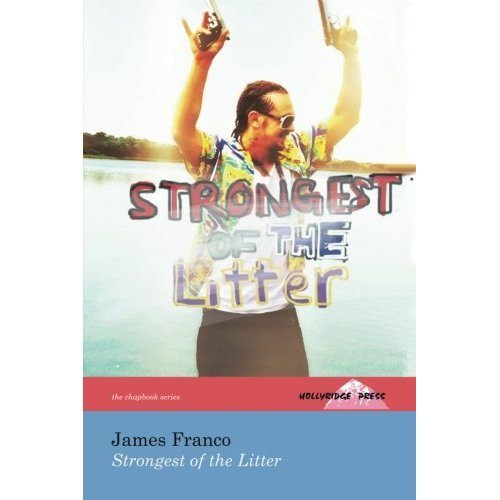
Alumni James Franco’s (poetry, ’12) poem “Film Sonnet 3” appears online in The American Poetry Review: 

He walks mindlessly, maniacally
Across the desert, like a Sam Shepard man,
A man who has been down to Mexico to die
Of a broken heart but didn’t die,
So he comes back to Texas, and then to Los Angeles,
Because all the cowboys retired to the movies.
Now they don’t even make Westerns anymore.
Paris, Texas, the name of the place
Where he bought some land, like a slice of Paradise,
But only in his mind. The real place
Is just a deserted plain in the middle of nowhere,
And his wife is working in a peepshow palace,
And you never think, but you should,
He was too old and ugly for her in the first place.

Alumna and current Joan Beebe Teaching Fellow at Warren Wilson College, Colleen Abel (poetry, ’04), discussing her approach to teaching poetry at a service-oriented institution is featured in the blog series “Writing Lessons” at Ploughshares

colleenabelRecently, poet and scholar Seth Abramson released a list on The Huffington Post called “The Top 200 Advocates for American Poetry.” The list included writers, teachers, publishers, founders of listservs and writing centers, and celebrity Friends of Poetry like Bill Murray and Patti Smith. Abramson didn’t define what he meant by advocacy, but I imagine he meant things like word-spreading, cheerleading, and trying to make poetry reach a wider audience—which most of us agree that poetry needs.

On the same day that Abramson published his list, I was participating in orientation activities at the school where I’ll be teaching this fall, Warren Wilson College in Asheville, NC. As I’ve heard a dozen times over the course of orientation, WWC is the only school in the country with an integrated work/service/learning program. In other words, students here spend 15 hours a week on a work crew. They are the college’s janitors, cooks, constructions workers, landscapers, foresters. On top of the work crew—and, of course, their studies—students have many, many hours of required service volunteering in the community, taking service classes, and attending issues workshops. (The other day my son tumbled through an intricate Asheville playground built in five days by WWC students).

Read more

Alumni Jamaal May (poetry, ’11) is featured on the Poets & Writers blog discussing how to give a not terrible reading:

jamaal_may-494x394Writers frequently ask me how to get more readings. I’ve said for years I don’t know why people give me money and sit still to hear me recite poems. But now that this bizarre phenomenon has occurred more than 600 times in the last nine years (three funded by P&W), I have to admit I do know why I get so many readings, and only part of it is luck. The truth is people like to hear me read. So the better question to ask is “How can I give better readings of my work?” Below are my top five tips.

Use Your Everyday Inflection

It’s remarkable to watch a poet charismatically engage an audience with banter then slip into a monotone drone when the poem starts. I suspect part of the reason for the “monotone drone” or the equally disheartening “poet voice” is a fear of performing. Writers tell me they don’t want to perform or be seen as performative. I would argue that an overly dry, disengaged reading is in fact a performance. No one speaks that way. Conversely, our daily conversations are full of varied inflection and shifts in tone. Rather than try to perform a poem, practice reading it in your own voice as if you’re telling those lines to a friend.

Read more