At last dates have been set for the 2021 mid-year Warren Wilson Alumni Conference, aka Wally Camp. Clear your calendars, polish your pencils, and get ready to register!
Wally Camp dates: Thursday, March 11 – Sunday, March 14
Note that this does not replace the 45th Anniversary Warren Wilson MFA Alumni Conference. That will take place some time this summer (probably in July). Stay tuned for details!
REGISTRATION DEADLINES:* FEBRUARY 25 – If you wish to read, lead a class, or be in a workshop/manuscript review group. (Submit any materials for class etc. by MARCH 4 to [email protected])*
MARCH 1 – To attend readings and classes only.*
Note: For simplicity, times listed on the registration form are Pacific Standard Time (PST). Please adjust for your time zone.
OFFERINGS:
* SMALL GROUP WORKSHOPS IN FICTION & POETRY. Mixed-genre, as well, if there is enough interest.
> Weekend mornings will be set aside for workshop meetings, but groups can choose to meet at another time of their choosing. Groups should arrange their own way of meeting (video conference, phone conference, email, in person, etc.). We do not have a way to do that for you.
* MANUSCRIPT REVIEW groups to workshop whole collections/longer works in progress.
> Weekend mornings will be set aside for workshop meetings, but groups can choose to meet at another time of their choosing. Groups should arrange their own way of meeting (video conference, phone conference, email, in person, etc.). We do not have a way to do that for you.
* CLASSES & LECTURES. Try out your fall syllabus or work through that essay idea sitting in a drawer: your student body awaits.
* PANEL & CAUCUSES. All of the discussion, minus the late return on results. A subset of the group or the whole community can come together to discuss specific craft topics or issues of interest to alums.
* BOOKSHOP. A deep dive into a poet’s latest work, a favorite short story, or an aspect of a novel. You get the idea.
* PROMOTE YOUR BOOK or other media! Include publisher and vendor links so alumni can enjoy your work! (Sorry, just complete works, not journal publications, etc.)
* SUPPORT FRIENDS OF WRITERS! There is no fee for this online conference, but if you are able to make a donation to FOW, you will enable alumni in need to receive financial assistance, as well as provide scholarships for future MFA students and alumni prizes.
Questions? Please be sure to review the information here and on the website carefully. If you still have a question, send an email to [email protected].
The conference is restricted to those who are graduates of the MFA Program for Writers at Warren Wilson (previously at Goddard).
For the past thirteen days I’ve been sleeping in the canoe hanging in our garage. The canoe is aluminum and wider than it is high, but still a canoe: a raised middle seam, two plank seats, and bars bracing the center. It’s suspended from the ceiling by pulleys, tied off so it dangles about a foot above the cracked cement floor. Our house is only seventeen years old, but it was constructed from shabby materials and so the floor’s cracked prematurely. I’ve confined myself out here to keep from contaminating my children with my sadness, indecision, existential crisis—whatnot.
It’s a harebrained idea, but literally, it’s all I’ve got. At least that’s the case I made to my family for why I’m out here in the garage when our perfectly good house is just steps away. My shrink said that if you can get a person through the first ninety days following a suicide attempt, it’s statistically remote that they’ll try again.
Of course, our insurance only covered three days of inpatient care, which is why I’m out here on my own recognizance with seventy-four days still to go.
Eating is one of the many logistical problems this arrangement causes. I don’t want to come inside and put myself back at the table and so my kids have been taking turns bringing me food. Earlier tonight, Zack, my oldest, came out with a glass of milk, gingersnaps he’d baked himself, and his headlamp from camp so I could see what I’m doing out here. Zack’s like that, quiet, so I think he’s zoned out but then he’ll do something unexpected and I’ll see that he’s been paying rapt attention.
“Are you trying to get me fat?” I said, reaching for the cookies. “Dad help?”
“Made’m myself,” he beamed. He’s always been a good cook. When the boys were little I used to joke that we baked for sport.
We used to do a lot of things for sport, David and I, before the kids, before the routine of being full-time working parents, mortgage holders, and weekend lawn mowers. Our neighbors, Dahlia and Steve, still come and go with exhausting regularity. Dahlia’s always exhorting us to get out there and keep exploring new things, but we just barely seem to make it to work, school, the grocery store, and home again. David says, “It’s enough.”
It is enough: two kids, a home, friends, family—it’s everything I thought I wanted—but I didn’t think a life so full would feel so small, so pointless in the larger scheme of things. What’s worse is that David thinks everything is great—fine, at least. “But you’re the assistant manager now,” he said the last time I brought this up, roughly four weeks ago.
If you’re looking for a cause—I am—his actions and words don’t seem like enough to have pushed me over the edge.
My fear, and it appears justified, was that there was no one BIG thing. It’s not that I’m suppressing some major psychological issue that caused me to—
Okay, let’s talk about that for a minute. I mean, yes, I slit my wrists, but—c’mon, I picked the least promising way possible to kill myself. I know the statistics on efficacy. “If I really wanted to kill myself I would have put a shotgun to my head,” I told my doctor. “That’s ninety-nine percent effective.” The way I chose only works roughly six percent of the time.
Obviously, I didn’t mean it.
I have always wondered what would push a person right over the edge.
that I love every person in this room. I mean it. We’ve traveled from all over to be here, and I love each of you, all of you, every last one of you, except Harold, but the rest of you I love fervently and without limitation. It’s important that you believe this is a boundless love, rhapsodic, without timidity or hesitation, because everyone is deserving of compassion, absolutely everyone, just not Harold, but for the rest of you, this affection is perfect, unconditional and free. Not “unconditional” with air quotes around it, not unconditional like a gatekeeper in the garden saying, Look at the fruit but do not shovel it into thy weird little face, saying, Love me and none other, saying, The first born, the locust, the welt of grief I’ve pressed upon your back; it is a truly unstoppable wave of tenderness that doesn’t traffic in punishment or retribution.
https://friendsofwriters.org/wp-content/uploads/2021/12/Post-Fallback-Small.jpg500500friendsofwritersbloghttps://friendsofwriters.org/wp-content/uploads/2021/12/FOW_logo.jpgfriendsofwritersblog2021-01-21 19:21:002022-02-25 17:18:07“Before We Go, I Want to Publicly Acknowledge,” by Matthew Olzmann
JC: You’ve noted that once you told a former writing instructor you were writing about “People held hostage by the circumstances of their lives.” Are you still inspired by that perspective?
CH: I suppose I am, but the more I’ve thought about the line, the more meaningless it is. I mean, who isn’t held hostage by the circumstances of their lives? Even when those circumstances are favorable, we’re so shaped by them that they affect our sense of what is and isn’t possible or desirable in life. Even when someone’s material circumstances would allow them to safely pursue a different kind of life, their circumstances might keep them from recognizing that or wanting to.
As a parent, I’m terrifyingly aware of how responsible I am for shaping my child’s sense of what is normal, or desirable, or achievable. Maybe one difference between the stories I was writing when I first said that, and more recent stories, is that those earlier protagonists were struggling to survive, to jump to the next rock in the river and not drown. Currently I’m interested in how people decide what direction to leap in, what blend of imagination or desperation prompts someone to either try to cross the river, or to stay put. Do we stay or go, and how do we imagine what might come next?
https://friendsofwriters.org/wp-content/uploads/2021/12/Post-Fallback-Small.jpg500500friendsofwritersbloghttps://friendsofwriters.org/wp-content/uploads/2021/12/FOW_logo.jpgfriendsofwritersblog2021-01-18 19:12:002022-02-25 17:18:07“The Menu Options Have Changed,” by Mike Puican (Poetry ’09)
We invited them over, from their fields to ours. To join us naked and playful, to give them Hope. To watch us joyfully trample our own lands— And witness the greening anew overnight. Our fields. Paid for, no mortgages— To join us in and outside of our tents of celebration, And share our jungles and waterfalls.
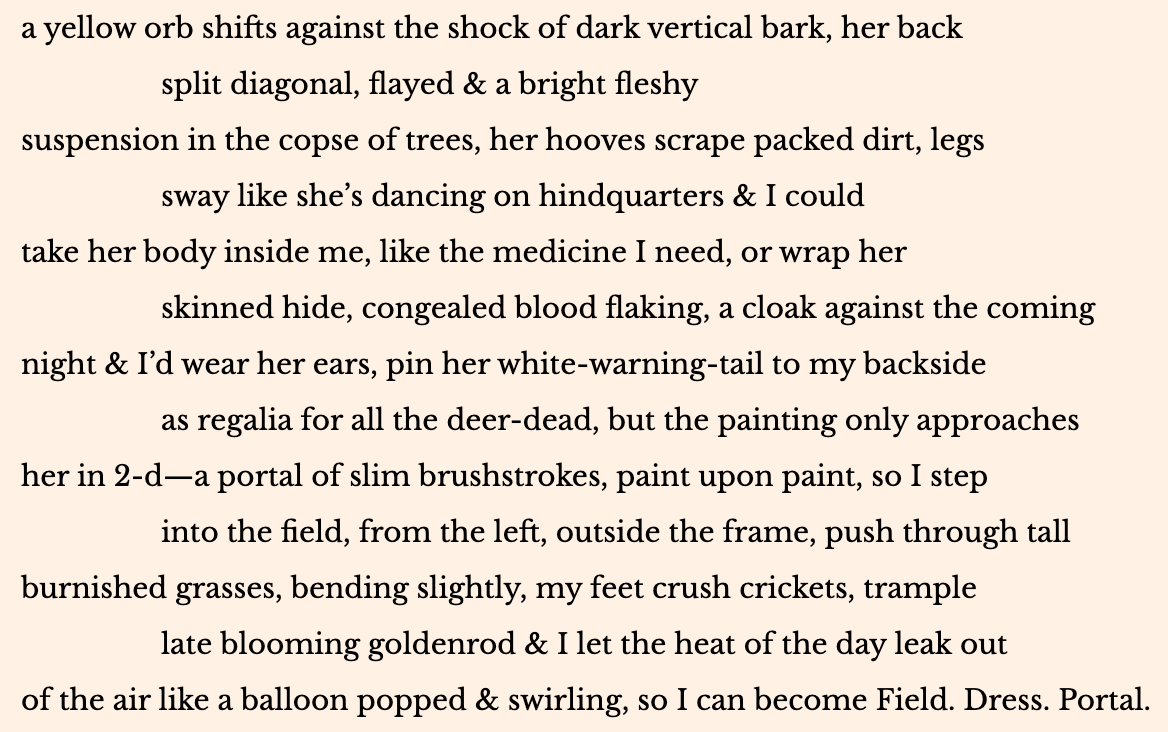
https://friendsofwriters.org/wp-content/uploads/2021/12/Post-Fallback-Small.jpg500500friendsofwritersbloghttps://friendsofwriters.org/wp-content/uploads/2021/12/FOW_logo.jpgfriendsofwritersblog2021-01-06 23:50:002022-02-25 17:18:04“Field Dress Portal,” by Sarah Audsley (Poetry ’19)
https://friendsofwriters.org/wp-content/uploads/2021/12/Post-Fallback-Small.jpg500500friendsofwritersbloghttps://friendsofwriters.org/wp-content/uploads/2021/12/FOW_logo.jpgfriendsofwritersblog2021-01-05 23:37:002022-02-25 17:18:03“Hang Man (Woman),” by Glenis Redmond (Poetry ’11)
he day before her son eloped, the rains came and the river increased. She recalls the immense, confused sound in the woods behind their home. All day, dense endless thunder. In the evening hailstones gathered in strings along the iron lip of the gutter.
By then she’d forgotten the romantic overtones—eloped—word for lovers. She hears it still. The palm-warmed pebble tossed against the upstairs window, the trestle descent—but not for her child, her boy. Autistic children do not run away with lovers, they just run off with themselves. What must it be like to have such a slack sense of home, or attachment? “Elopement,” as the clinicians say, a behavior half of all autistic children engage in. Another form of wandering, of withdrawing, from her, from her love, her need of him, which grew stronger only as he grew older and more independent of her, more willing to shrug her off—to shrug the world off too, water off a duck’s back.
▴ ▴ ▴
If her son had shoes on when he left that morning, the river took them. The river took everything but his bicycle helmet. The bright orange one, perhaps the only reason the body was found at all, the parents were told, as though they should be grateful he had been wearing it.
▴ ▴ ▴
At night, the mother sees the orange helmet winking out from behind the stilt grass, flashes of it in the corner of her eyes, and when she turns she sees him, under the bright cap, the pale stamen of her son drifting, naked boy with his long hair—surely they thought he was a girl when they first came up on him—her darling in the bulrushes.
▴ ▴ ▴
Her son of so many shades. A gelding changing color. Their nonverbal son; their distant, open-mouthed son; their angry, self-absorbed son; their beauty queen son; their supple, warm-skinned son with the long fragrant hair; their stubborn son, barnacled to the steel pole in the supermarket; their ecstatic son, limbs outstretched on a bright fall day outside his grandparent’s house, dancing; all of their sons, all gone, all flown out like swallows into an aperture of severe self-light.
▴ ▴ ▴
He was diagnosed officially by four, suddenly stopped speaking at three-and-a-half, all in a few weeks, a month perhaps, from compound sentences, to phrases, then a few last words, like a good-bye. After that it was only gestures, if anything.
▴ ▴ ▴
Anything, that is how the mother remembers feeling, how acute her anger could become. She would take anything from him. She had never wanted to shake her child, but in those first months of regressive onset, she could not stop herself from asking him, “Thomas? Are you okay? Are you okay? Are you okay?” and how she hated her reliance on that question, how she never said anything else to him those days, only asking, pleading, was he okay in there, was he hurting in there, was he scared in there? Was he okay? Because he seemed in pain, or hurt, the way he scrunched his face, closed so tightly his eyes. And his silence was so awful, and sudden. Are you okay? Are you okay?
▴ ▴ ▴
How she wanted to hurt him, she admits this now, how she wanted to make his agonized gestures correspond to something real, to make his clinched eyes correspond to the world as it was. She wanted to place something hot in his hand and see him do something about it, to see him hurting because of something outside. Something she could then remove, and say, all better, all better. She is not ashamed.
They tickled him, but instead of the normal squeal, the look in the eyes that before had pleaded with delight, “no more,” he would instead go stiff, eyes wide as though listening to something far off.
In the mornings, she would go in to find him manipulating his tongue in his mouth, his eyes clamped shut as though focusing very hard on something. It reminded her of someone trying to tie a cherry stem into a knot, though more involved. Each time she found him this way she would pry the mouth open, convinced and scared he actually had something in there. And it was always empty. Empty and empty and empty. This lovely mouth with its full lips, mouth that had before held songs, and laughter, and such precise little demands.
▴ ▴ ▴
This is autism, she is told, over and over again. This and this and this. The word alone, whenever she hears it or is forced to use it, like a door getting slammed upstairs in a big drafty house, a house growing ever bigger now, big enough to contain all the new things she is fearful of.
The word itself was first used to describe a particular kind of self-absorption noted in schizophrenic patients in 1908. Auto. Self. Selfism. It sounds judgmental to her. Why would you do this to yourself? And then, in the forties, child psychologists decided it was not a form of schizophrenia at all, but something else, some other wilderness of the mind. That’s about as far as they have gotten. And yet, they kept Eugen Bleuler’s troubled word. Autism.
▴ ▴ ▴
His arms swung over his drawn-up knees again, his hands together, his whole body rocking, not wildly rocking, but gracefully, rhythmically, his long fingers interlaced and bumping up and down just so on his shins. His eyes remain fixed to the side, into an empty corner. The eyes are moving as though someone is there, dancing.
https://friendsofwriters.org/wp-content/uploads/2021/12/Post-Fallback-Small.jpg500500friendsofwritersbloghttps://friendsofwriters.org/wp-content/uploads/2021/12/FOW_logo.jpgfriendsofwritersblog2021-01-04 23:33:002022-02-25 17:18:03“Now There Is Only You,” by Nathan Poole (Fiction ’11)