
Dilruba is interviewed by fiction writer and essayist Curtis Smith

Curtis Smith: Congratulations on Bring Now The Angels. I really enjoyed it. Being part of the Pitt Poetry Series is quite an achievement. Can you share the manuscript’s path and how it found a home with Pitt?

Dilruba Ahmed: Thanks, Curt! I received the good news from Ed Ochester in March of 2019.  The acceptance note came from an unfamiliar e-mail address, so initially I was uncertain!

Over the course of 2-3 years, I’d sent versions of the manuscript to various presses, revising heavily (and retitling) several times.  In fact, Pitt rejected an earlier version of of the manuscript in 2018.  Various precursors to Bring Now The Angels were a two-time finalist for the Kundiman Poetry Prize from Tupelo Press; a semi-finalist for the Lena-Miles Wever Todd Prize from Pleiades Press; and a 2nd runner up for the Benjamin Saltman Award from Ren Hen Press.

Even after Pitt accepted the manuscript, I subjected it to another round of substantial updates before submitting the truly finalized version to the press.

The staff at Pitt are lovely people and I can’t thank them enough for their support of my work, and for the amazing cover they created.  All along the way, I was lucky to get the feedback of several trusted readers to guide my revision process, especially that of my dear friend, poet & editor Ross White, whose book Charm Offensive is forthcoming from Eyewear Publishing.  He & I have been tradingpoems and draft manuscripts for years.  My poems evolved only with the gift of Ross’ keen eyes on them.

Read the rest of the interview here: https://jmwwblog.wordpress.com/2020/05/18/letting-go-an-interview-with-dilruba-ahmed-by-curtis-smith/?fbclid=IwAR2grXZ-mQJRmufvztfg5kocFyYkTsZB1nKabrn3TLmkmrcmU0iAYQhdgms
Is there a moment, image, memory, or experience from your childhood that jumps out at you now as hinting at or communicating the possibility that you would become an artist, a poet?

Tommye Blount: Nope, never a poet—ha! That was never a part of my thinking as a child. The need to tell a story, however, was always there. My mother worked in an office at Michigan Bell, a typist of some sort. I forgot how it all started, but she would bring big reams of dot matrix paper home. The sight of it just made me so excited. There was something so stimulating about seeing all of that blank space with no lines or margins. It was very different from the green lined paper we would use learning cursive in school. This was an invitation to fill up as much space as I could. I would doodle and write all over the sheets. There was a child’s hunger for maximalism that faded in my teen and part of my adult years.

In those years, and still now somewhat, there is safety in wanting to take up as less space as possible. It’s partly why the book is big. A challenge to myself, I wanted to force myself to take up, and earn, the space of this book. In a world that would rather deny me, a Black gay man, space I wanted to claim it for this book. I did not come to the realization on my own, but it was partly seeing the work of Detroit artists like Tylonn J. Sawyer and Sydney G. James—artists who have created massive murals in which every wrinkle and hair of its Black subject must be reckoned with. When one encounters the work, they have no choice but to consider the subject.

Read the rest of the interview here: https://lithub.com/tommye-blount-no-one-gets-off-the-hook-in-my-poems/?fbclid=IwAR2lLUAhrUsvUJXRmp15qdL412725J88k3c0BogXyvkbkPXkh-Ke5ztIUk4


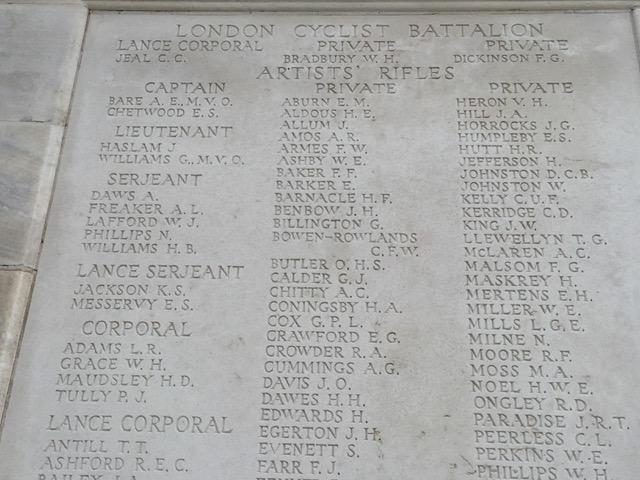
HARM
Just north of Railway Wood
British Trench Map Sheet: 28 NW 4 Ypres
 
 
We are no longer confused about harm.
 
Harm is in specific locations. 
I.5.d.9.1, for example, the small field
100 yards due east of Gully Farm.
 
We strive to remain unattached,
without attraction or aversion
to material forms. 
   The way
Phillips and Mercer did,
who understood such distinctions.
 
Most of them is still missing.
 
Cover and excerpt courtesy of New Directions

Perry Janes 2019 poetry graduate Perry Janes recently had a poem featured by the Poetry Foundation. Read an excerpt of “No Thanks” below:

No Thanks

After W.S. Merwin, sort of

listen
            every day the world is making its meager
mea culpas for Easter peeps arranged on dollar store plates
            at dinner parties invisible fences the dogs run past
for bleach-stained laundry fresh from the laundromat

Find the rest of this poem here: https://www.poetryfoundation.org/poetrymagazine/poems/153199/no-thanks

Dispatch from a Pandemic: Chicago,” by Peggy Shinner (Fiction ’94), was recently featured in Another Chicago Magazine. Read an excerpt below:

Dispatch from a Pandemic: Chicago

Do we all have secrets now?  A friend of mine is unspeakably happy, because she’s fallen in love during the pandemic.  She’d been widowed over thirteen years ago (not a term I’ve ever heard her use but what is the term when you’re queer and grieving?), C. died of breast cancer, and now R. is bleary-eyed with sex and wonder.  She and N., her new love, hold hands at the table.  They are building raised garden beds. They wear bandanas that make them look jaunty and their faces are alive with pleasure.  R. is an activist, and before the primary she, N., and others hung a banner over the Eisenhower Expressway urging people to VOTE.  And my secret, in this time of vigilance and side-eye surveillance?  I resist the rules.  I wear a mask, but only sometimes.  No when I’m running and walking, yes when I’m shopping.  I feel confused and defiant.  I don’t always want to be trying to evade death…

Read the rest of this piece here: https://anotherchicagomagazine.net/2020/05/10/dispatch-from-a-pandemic-chicago-by-peggy-shinner-2

Delivery By Mouth,” a poem by 2016 graduate Lara Egger, was recently featured in the Washington Square Review. Read an excerpt below:

Delivery By Mouth

Most weeks I’m accordion but I’d prefer to be harmonica.
My body language is easier to read with the lights turned off.
Accord and harmony are synonyms
for the parts of speech that leave a lump in my throat.
At the dinner party someone says,
Sorry for all this talk about pregnancy.
Wolves are in the water. Wolves are in the water
so the water better learn how to swim.

Find the rest of this poem here: https://washingtonsquarereview.squarespace.com/lara-egger

The Mathematician’s Daughter,” a short story by Sonja Srinivasan (Fiction ’19) was recently published by The Write Launch. Read an excerpt below:

The Mathematician’s Daughter (A Modern Victorian Tale)

The shortest distance between two points is a straight line. She jerks her head up with a start and sees the clock–9:40 a.m. There just might be time! There just might be time if Nancy runs fast enough, time to see John and confess her love for him. She has been working on a proof all night and has fallen asleep at her desk and is late, is late, for a very important date, and now she doesn’t know if she can catch him before he catches his plane. But how quickly can she descend that damn staircase that begins outside her door, the staircase that is an endless Fibonacci sequence that spirals and spirals down? Those old worn stones might cause her to trip over and chip a tooth, the fragment cleaving off in a perfect right triangle. She runs faster and faster, her hair trailing behind her, her footsteps echoing off the walls. These old Oxford colleges like Magdalen are more trouble than they are worth, though they are prestigious and date back from the 13th? 14th? 15th? Century, full of lore and history and funded by the coffers of kings and dukes and marquises, for they are damp and chilly and dark, unwelcome places to call one’s abode.

Read the rest of this story here: https://thewritelaunch.com/2020/05/the-mathematicians-daughter/

Anna Solomon Faculty member Anna Solomon‘s new novel, The Book of V, was recently excerpted in Vogue. Read the opening below:

The Book of V

It happened in the days of Nixon—that Nixon who presided over fifty states, from the Florida Keys to the Aleutian Islands. In those days, in the fifth year of Nixon’s reign, when the scandal that would undo him was erupting in Washington and beyond, a great, unspoken license was given to any official who was not he. A veil of distraction fell over the capital’s swampy fortress and a lustiness took hold, an appetite for drink and women uncommon even among that time and people. It followed that a banquet of minor scandals, insults, and crimes was enjoyed in the town houses of powerful men. There were floor-to-ceiling drapes of heavy velvet, and there were couches of Italian leather on sheepskin rugs. The wineglasses were nearly invisible, the low- balls weighty as a man’s fist. The rule for the drinking was, *Drink! Among these men was one, Senator Alexander Kent of Rhode Island, who gave no fewer than five parties in one month, displaying his home, his wife, and his good taste in scotch. To the fifth party, which would be his last for a very long time, Senator Kent invited not only those colleagues and donors he counted among his friends but also one man who was obscure in the capital but famous in Rhode Island for the suitcase-manufacturing empire his family had built. Kent invited this man to address a quickly spreading rumor he hoped to learn was untrue: that Suitcase Man was planning to endorse Kent’s opponent in the following year’s election.

Read the rest of the excerpt here: https://www.vogue.com/article/fiction-friday-anna-solomon-the-book-of-v

Poetry faculty member Sandra Lim recently had a poem featured in The New Republic. Read an excerpt of “That Are” below:

That Are

Then I became this stupid, trilling thing:
what I desired was to become obscene.

All the things I had loved up to then
fell away in the long struggle between winter and spring.

And then there was my body, inside of my soul.
It had different aspirations.

What form does it take without the soul?

Find the rest of this poem at The New Republic.

Grapefruit,” a poem by 2009 poetry alumna Angela Narciso Torres, was recently featured in the American Poetry Journal. Read an excerpt below:

Grapefruit

Cutting through the equator of a grapefruit, my blade sinks into pink pulp.
A day like any other—warm gusts when I let the dog out.

Thirteenth of September. Mother’s birthday. Gone four moons.
I slip into her kaftan of orchids and zebra stripes, brew manzanilla tea…

Find the rest of this poem here: https://www.apjpoetry.org/grapefruit