
Poetry alum Leigh Lucas was recently featured in Two Hawks Quarterly. Read an excerpt of “Baby, This is Just to Say” below:

Baby, This is Just to Say
I don’t speak French very well so today I said to my cab driver, Virginie,
I said, Me, now, I am always proud, because if there is something, I can do it! Me. I can.
Do you understand?
To which she responded, Oui, which was mostly just nice of her
because I didn’t really either but I couldn’t stop speaking, I felt just like
a moon bounce on the up-jump, I said,
I can do things, just at me, all alone! I practically shouted it.
C’est merveilleux, she responded, and then I loved her as much as I love anyone in the world.
It was hard for me to say goodbye,
so I gave her my number in case she ever wanted to call,
no pressure, I said, but she didn’t understand because I said it in English.
Read the full poem here: Baby, This is Just to Say by Leigh Lucas – Two Hawks Quarterly
Leigh Lucas on the web:
2017 poetry alum Nomi Stone was recently featured in The Rumpus. Read an excerpt of “The Feeling Kept Growing” below:

The Feeling Kept Growing
Then, all the animals were Bearo & all
the boys, Gilly. A curly-horned
ram came over the hill: gently his snout
hurt into my morning. Algae at the lip
of the sea on my left, that green sear,
& fungus gloving the trees, while our kid
squawked in the pram, like he’d eaten
a happiness & wanted to roll it back
to share with the sea…
Read this poem in its entirety, as well as another, here: https://therumpus.net/2022/04/18/national-poetry-month-day-18-nomi-stone/
Poetry alum Chloe Martinez was recently featured in Beloit Poetry Journal and Palette Poetry. Read an excerpt of Chloe’s interview in Palette below:
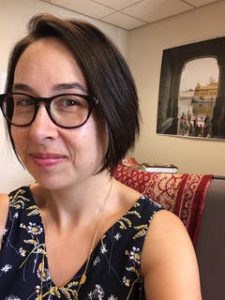
Chloe Martinez, poet and scholar of South Asian religions, has a long-breathed relationship with the work of Mirabai, one of the earliest known women poets, who lived in north India in the late fifteenth/early sixteenth century. An ardent devotee of the god Krishna, Mirabai (or Mira) is also known as a Hindu saint. Chloe first encountered her song-poems in college and has been rereading and thinking about them ever since. Eventually, she also began to translate them from the original Braj Bhasa, an early form of Hindi—and to write her own poems influenced, in different ways at different times, by Mira’s.
“By Mira,” Chloe tells me, “I should really say ‘Mira’: we don’t really know which poems were written by a historical person, since they were first sung and shared orally, then gradually written down over centuries. It’s nearly certainly true that other people wrote songs in Mira’s persona and signed the poems with her name… Nevertheless, there’s a corpus of poems that are widely known today as ‘Mira poems’ and that’s what I’ve drawn from in [my] translations.”
Read this interview in its entirety here: https://www.palettepoetry.com/2022/01/27/the-guest-21/

Subscribe to the Friends of Writers Forum and receive notifications of new posts by email.